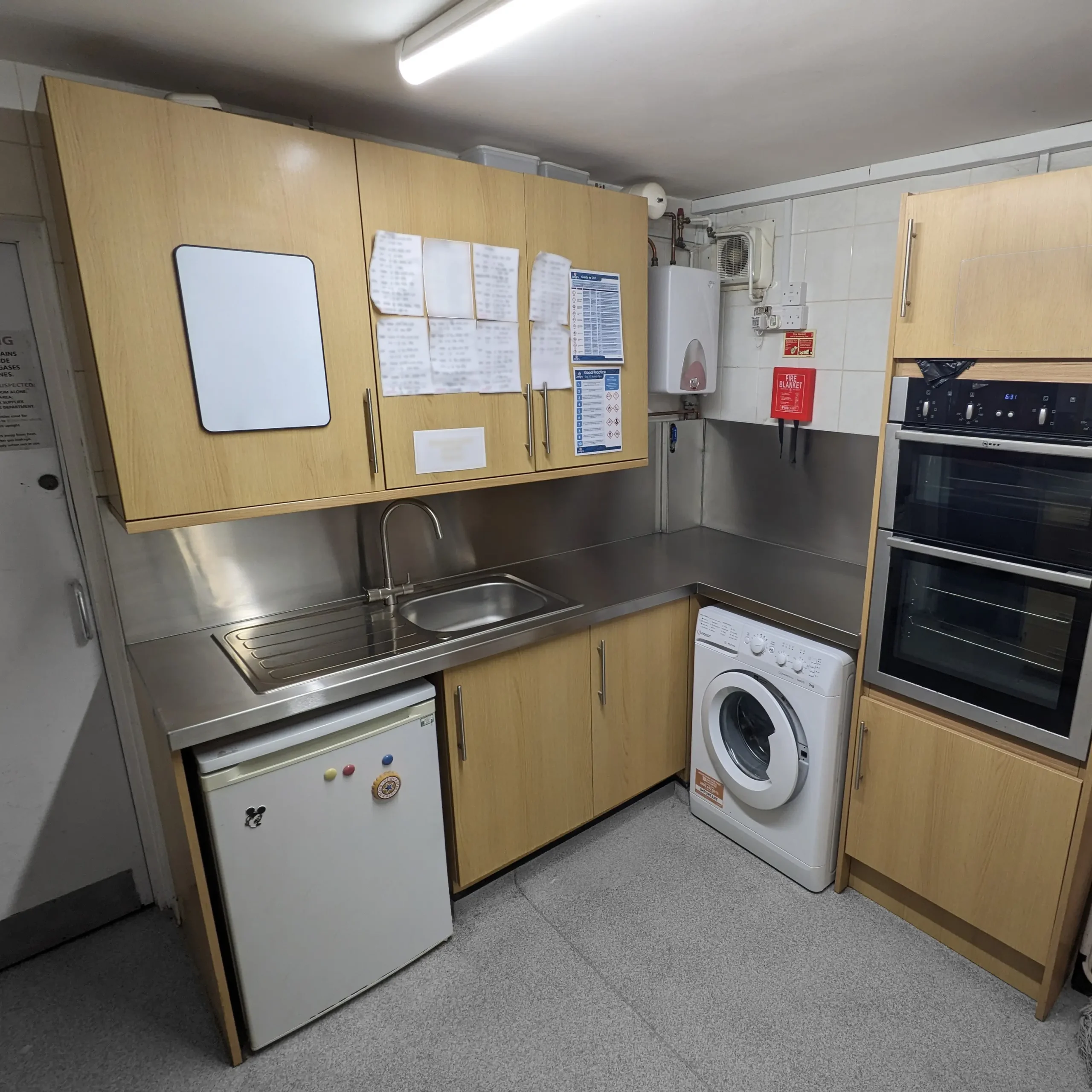
Fabrication and Install of Stainless Steel Worktops and Splashbacks to Existing Kitchen Cabinets
Project Summary
Client: Copthorne Social Club (local not-for-profit community organisation)
What we delivered: 2x stainless steel worktops and 4x splashbacks, supplied and fitted
Material: 304 stainless steel, 1.5mm thick
Finish: 240 silicone grit
Key aim: Make the kitchen quicker and easier to clean, and improve day-to-day capability
Completion: Dec 2025
Job Ref No: FF6868
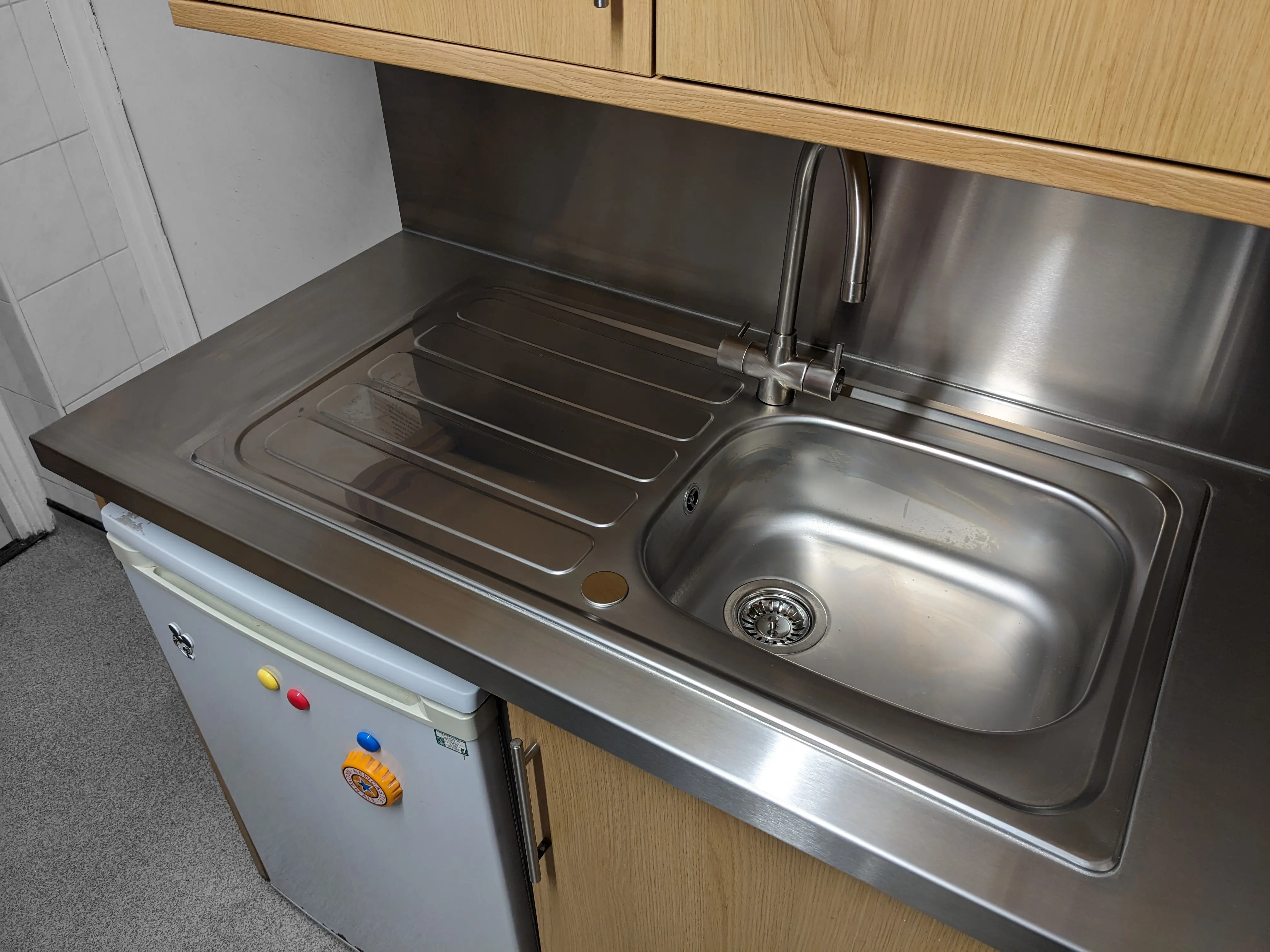
Copthorne Social Club wanted to upgrade the kitchen in their premises on a budget, without ripping it out and starting again. Retaining the existing carcassing and door fronts would keep costs down and keep disruption to their operations to a minimum. Like most old buildings, there are no straight lines – in this situation custom fabrication is usually a better solution than trying make an off-the-shelf product fit.
Installing stainless steel around existing cabinetry, work surfaces, and requires accuracy and care.
The brief was simple and practical. The club wanted a hygienic, easy to clean kitchen to cope better with busy service, as part of general upgrades to streamline their kitchen area. Stainless steel is the obvious answer for commercial environments, as it is hard wearing and can be fabricated with a minimum number of joins, which reduces cleaning time.
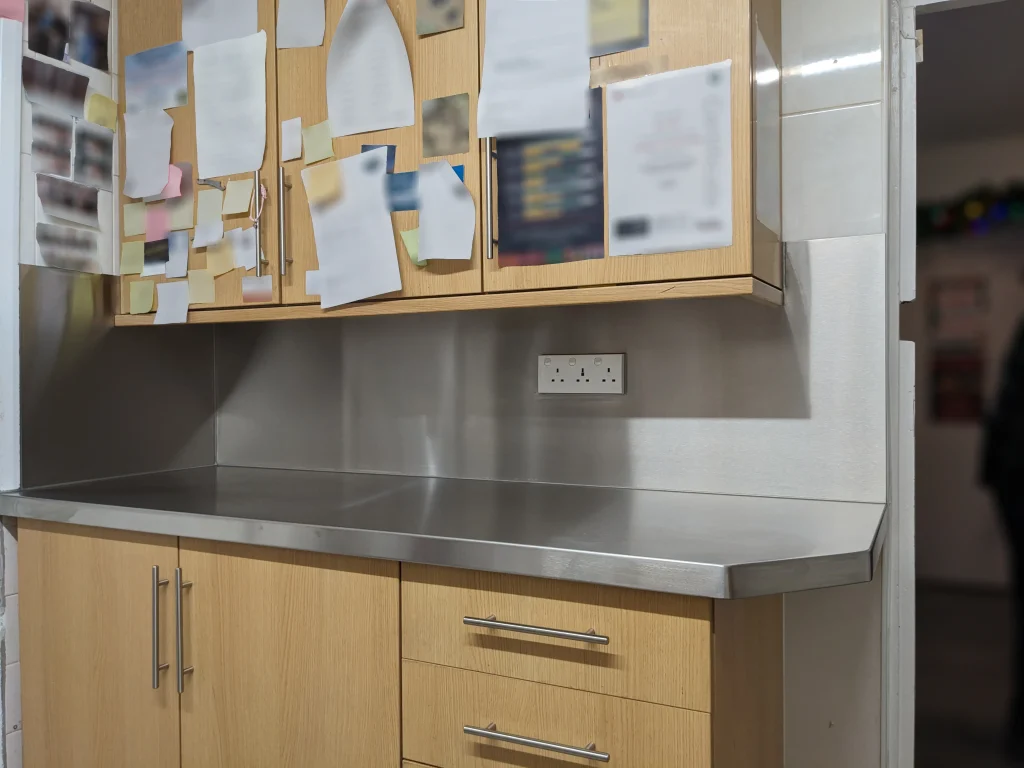
Process
Initial contact
Copthrone Social Club gave our office a call, and discussed their plans for the kitchen upgrade with one of our staff.
We discussed some key information:
Design brief
The client described their kitchen to one of our designers – they were improving their kitchen, but weren’t doing a full refit. They wanted stainless steel, were replacing the sink, and having electrical and plumbing work done to tidy up existing services. A new sink would be purchased, and they would provide us the spec so we could allow for the cutout.
- Requirements – Basic discussion of what problem the client wants to solve, how they want to solve it. We listen and make suggestions on design details, costs, and offer any alternative ideas we have for cheaper options, durability, aesthetics, or shorter lead times.
- Package of works – Is the work part of a bigger package of works that we will need to work with – site access, work that happens before or after our installation.
- Decisions still need to be made by the client – e.g. discussing finish with interior designer.
- Budget – if known.
Does it fit our manufacturing capabilities?
We discussed the kitchen size, edge detail, and fitting requirements to determine that we have the skills and tooling to handle the required fabrication.
We have a wide range of capability in-house, and also have specialist suppliers and subcontractors to meet unusual requirements.
Location
Copthorne is very close to our base in Smallfield, so it was cost effective to supply and install.
We discuss with clients on a project-by-project basis what will work – we have fabricated items that have been shipped internationally and installed by local installers, and as a general rule we can install cost effectively in London and throughout the south-east with our own installers. For large projects (e.g. high end staircases), we can install in most parts of the UK.
Timeline.
The client told us when they needed the kitchen to be completed. We discussed lead times, and client approvals needed, and upcoming events the kitchen would need to be in operation for.
Quote
Preliminary Site Visit
We organised a site visit to measure the carcass, check the condition of the existing worktop substrate, look at fitting requirements, services, site access for install.
Where possible, we organise a site visit as soon as possible.
When can the site be accessed?
Quote
We sent a quote to the client, with a sketch outlining the extent and scope of the work.
Invoice
When the quote was approved, an invoice was issued.
Invoicing schedules are agreed with the client on a project-by-project basis.
Fabrication
Detailed requirements agreed
After payment was received, we had a further discussion with the client about the requirements, building on the original brief with more detail. The client had chosen their new sink and tap, so the specification and dimensions could be confirmed with the client’s suppliers. The client revised the top line of the splashback following some work on the services, and the design was revised accordingly. Doors and drawers were checked for fitment, so that our installers wouldn’t have any surprises.
In design terms – the splashbacks unify the space. While it is not a kitchen that is in the sight of customers, it’s still important that everything looks good.
Detailed survey
We attended site for a detailed survey – it takes time to measure to check all the dimensions, so this work is done once the project has been confirmed as a job.
Shop drawings for approval.
With the detailed design work completed, shop drawings were provided to the client for signoff prior to manufacturing.
Installation
A date was agreed with the client for install, and when fabrication was complete, our install team went to site and installed the worktops and splashbacks.
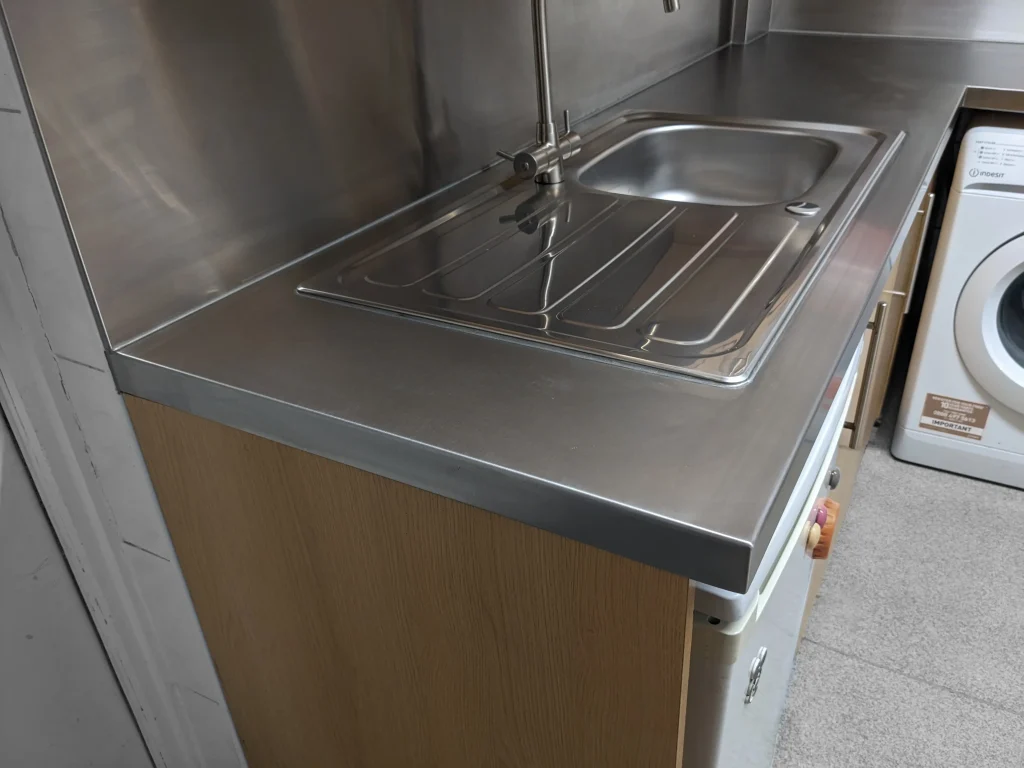
Fabrication Details
Worktops and splashbacks, fabricated in 304 stainless steel, 1.5mm thick. 240 grit finish.
Material:
304 is a grade of stainless steel alloy widely used in commercial kitchens, and it helped the client manage cost while still getting the performance benefits they needed. The other option would have been 316 – which is more resistant to some chemicals and salt, but is more expensive. Unless it’s specifically designed as a seafood kitchen where salt exposure will be high, 304 works for kitchens, and is cheaper.
Finish:
We specified a 240 silicone grit finish, with a brushed grain running in the direction of the longest length. Grain direction is not just cosmetic; it does affects how light moves across the surface, and how consistent the finish looks from different angles – but It also supports straightforward maintenance, because routine cleaning follows a predictable direction rather than cutting across the grain and making marks more obvious over time.
Installation and Finishing
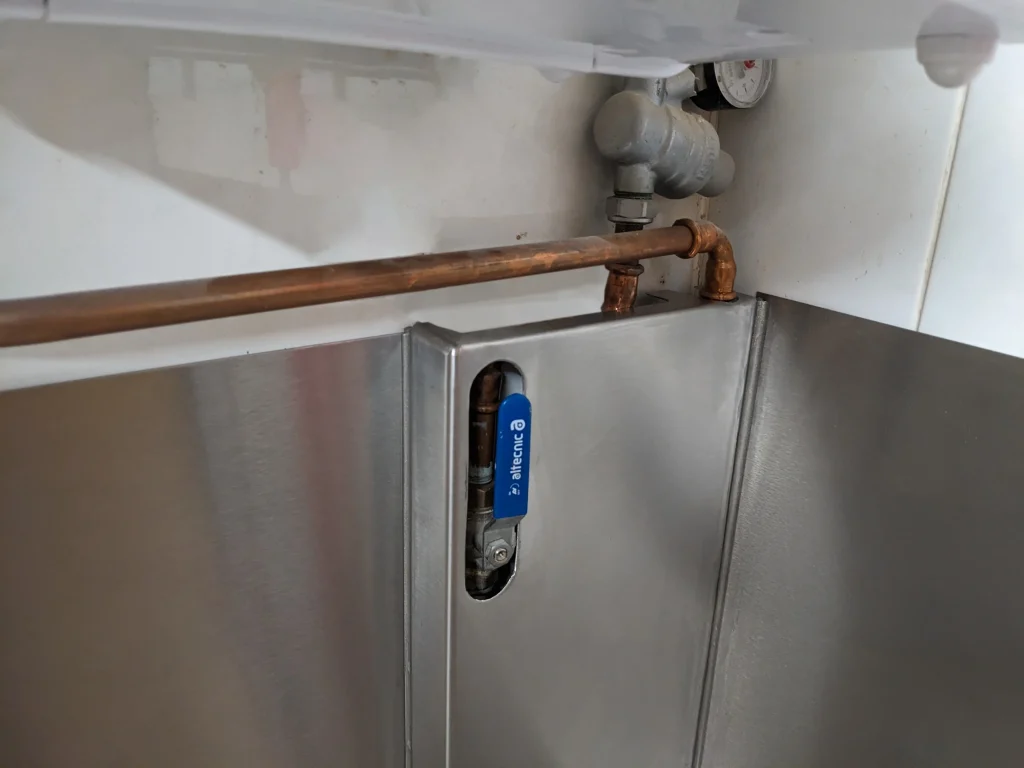
Fitting stainless steel into an existing kitchen is all about neat junctions and sensible sequencing.
Equally important were the edges and returns. Worktops in busy kitchens must be impact resistant. A carefully designed edge detail helps with longevity.
Result
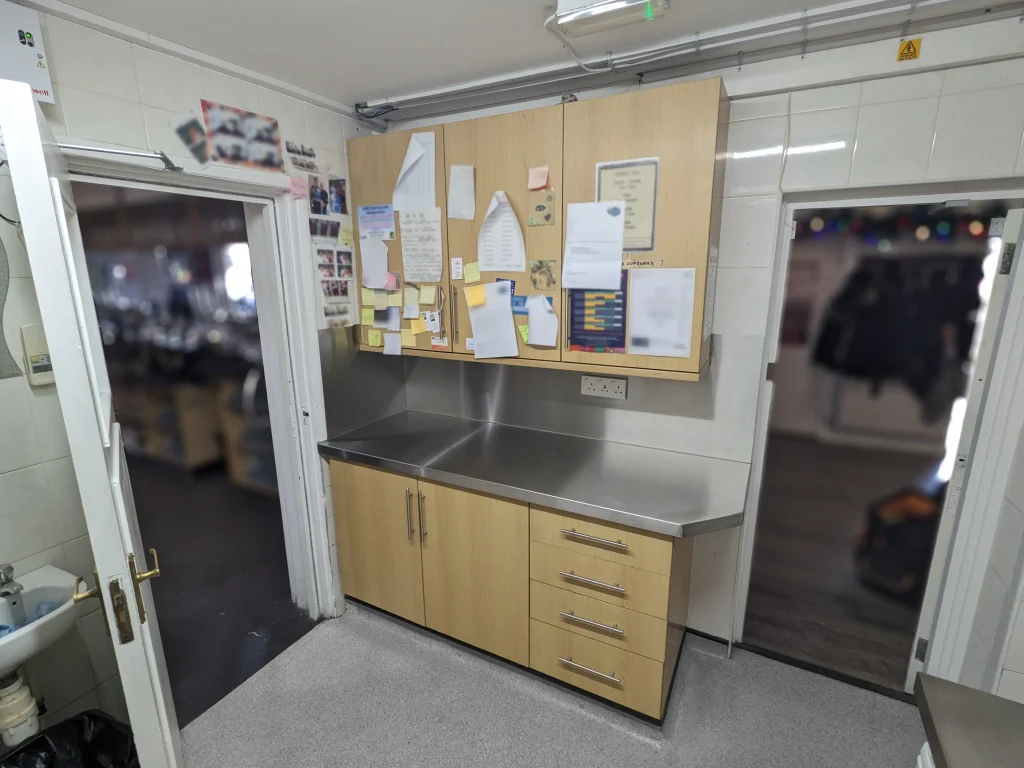
The outcome is a kitchen that feels easier to run and easier to look after. Stainless steel worktops give the team a surface that suits a commercial pace, and the splashbacks provide practical protection while lifting the overall feel of the room. Most importantly, the club achieved this without the disruption and cost of replacing the full kitchen. They kept what was still doing its job, and upgraded what was holding them back.
It’s important to us what this project represents for us locally. Copthorne Social Club is a community organisation – part of our local area, and we pride ourselves on being part of our local community, providing metal fabrication services, employment for our team, and being part of a network of suppliers, builders, and subcontractors.
If you have an existing space that needs to work harder, but you are not keen on a full strip-out, retrofitting can be a smart route. It is often the difference between “good enough” and a kitchen that is genuinely set up for service.
Next Step
If you want to explore a stainless steel retrofit, send us a few photos and rough dimensions and we will advise on options.
Call: 01342 719454